Taman Ayun Temple: The Relics of Mengwi Kingdom
The island of Bali has always offered beauty to its audience Taman Ayun Temple– especially tourists, stretching beaches, flowing waterfalls, pristine rice fields, to the popular mountains. But, Bali is more than that, Bali is home to a myriad of traditions and cultures, to ceremonies that you won’t find anywhere else. This should be more than enough to convince you to come to the temple. You’ll be able to see and hear Balinese culture passed down from generation to generation in a sacred spiritual journey.
However, there are even more temples in Bali than the number of days in a year. This is not surprising, because the majority of Balinese people are Hindus. That’s why, we recommend one of the temples that might answer your questions, Taman Ayun Temple.
Inside The Taman Ayun Temple
Taman Ayun Temple is located in Mengwi, Badung, about 31 Km from I Gusti Ngurah Rai International Airport and 8 Km southwest of Ubud. Its location which is quite far from the city center is actually interesting. As it is a lush place that is right for releasing fatigue from the bustle of the city.
Taman Ayun Temple is a significant cultural and historical site in the Balinese Hindu tradition. Known as the Paibon/Pedarman Temple of the King of Mengwi, it plays an essential role in honoring and worshiping the ancestral spirits of the Mengwi royal family.
The term “Paibon” refers to a type of Balinese temple dedicated to the ancestors of a royal family, while “Pedarman” typically relates to the shrines associated with such ancestor worship. In the context of Taman Ayun, the temple was established as a place where the kings of Mengwi could venerate their ancestors. This act of worship was embodied through the construction of a Paibon gedong. Which is a type of pavilion or structure within the temple compound dedicated to housing ancestral shrines or symbols.
The first king of the Mengwi Kingdom, I Gusti Ngurah Agung Sakti, also known as Tjokorda Blambangan, established Taman Ayun in 1634 during the royal era. However, a powerful earthquake in 1917 damaged Taman Ayun Temple. Therefore, repairs began in 1937 and continued in 1949. In fact, in 2012 UNESCO had designated Taman Ayun Temple as part of a world heritage site.
 Source: Badung Tourism
History of Taman Ayun Temple
The construction of Taman Ayun Temple took approximately two years, with its completion in 1634. I Gusti Agung Putu, the king of the Mengwi Kingdom, also known as “Mangapura,” “Mangarajia,” and “Kawiyapura,” created the kingdom. Ing Khang Ghoew, also known as I Kaco, a Chinese-descendant architect from Banyuwangi and a close associate of the Mengwi king, contributed to its design and construction. Initially intended as a private temple for the Mengwi royal family. The dispersed nature of other temples made religious activitiy challenging for the Mengwi residents. To address this inconvenience, the king conceived of this temple as a central and accessible place of worship for the local community.
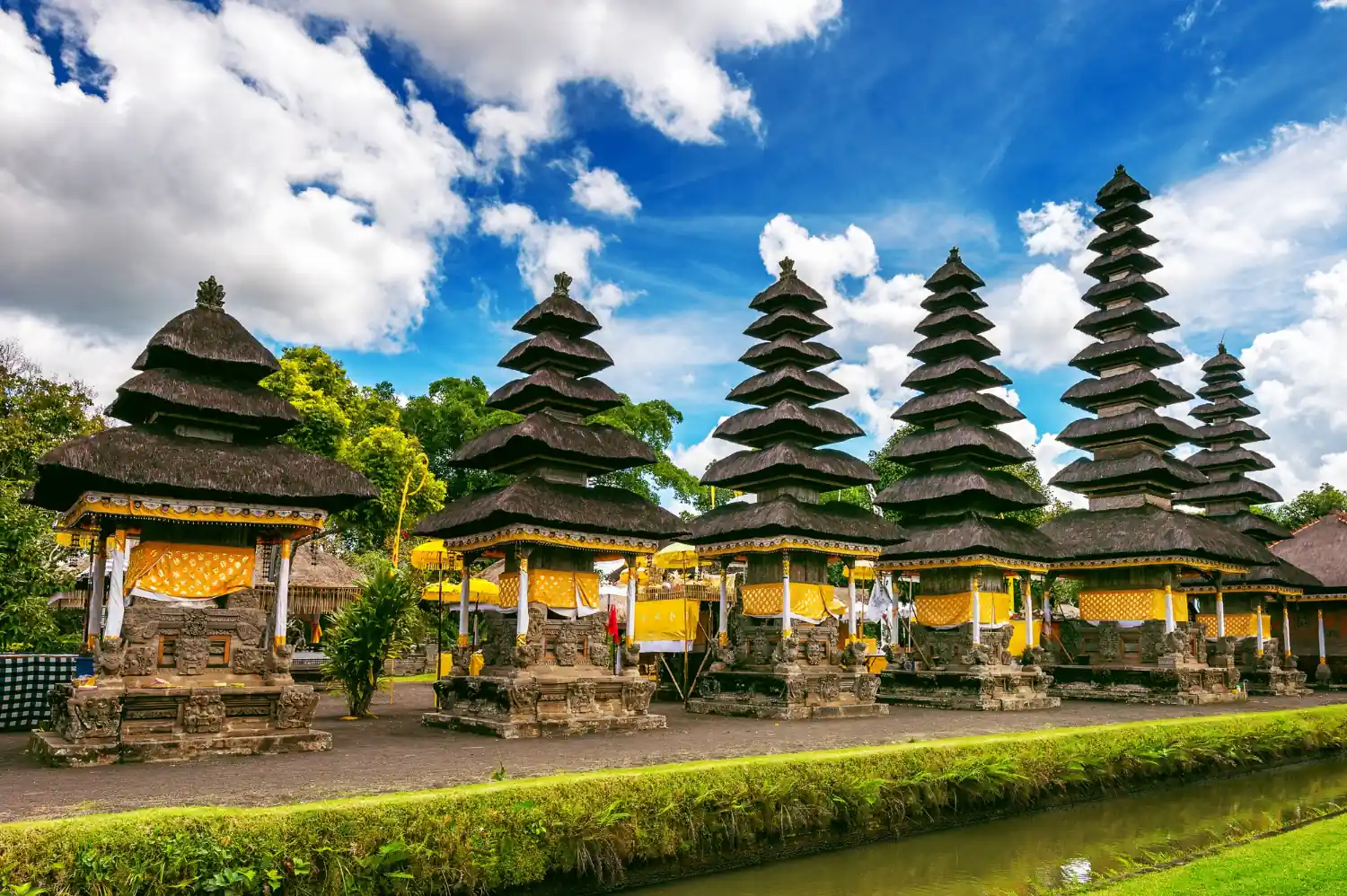
The temple complex is known for its architectural design, featuring multiple courtyards (known as ‘mandalas’) and merus (multi-tiered shrines). The complex is divided into the inner and outer courtyard, with the inner courtyard being the most sacred area. This layout reflects the Balinese cosmology, representing the spiritual journey from the outer world to the inner sanctum, where the most sacred shrines are located.
Over the years, the temple has undergone many renovations. The most significant refurbishment took place in 1937, which focused on the Kori Agung (magnificent gate), the Gapura Bentar (split gate), and the construction of the Wantilan (Balinese Pavilion). The Pujawali Ceremony, marking the temple’s anniversary, is celebrated every 210 days (about every six months) according to the Caka Calendar, specifically on Selasa Kliwon Wuku Medangsia, which falls 20 days after Galungan Day. On this special occasion, the local community decorates the temple buildings and participates in various religious rituals.
Exotic Temple Building
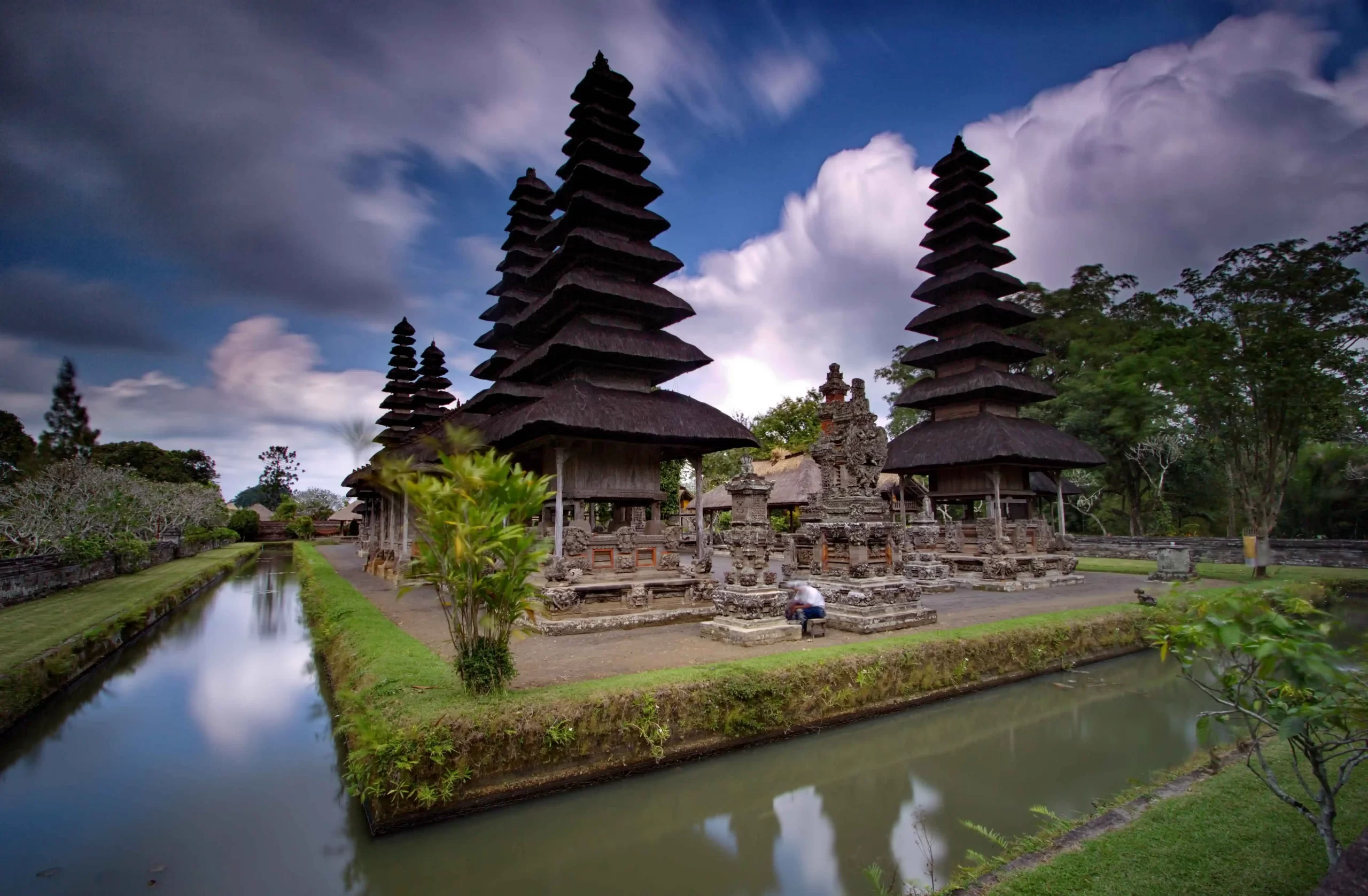
Taman Ayu Temple, also known as Taman Ayun Temple, is a significant historical and cultural and known for its beautiful gardens, traditional Balinese architecture, and the moat that surrounds it. The charm comes from the pool that surrounds the building complex, which is located on an area of 2.5 hectares. From a distance, the temple building looks like it is standing on the water. Taman Ayun Temple Complex stands on an area of 100 x 250 m2, divided into four distinct courtyards, each one elevated above the other.
Jaba (Nista Mandala)
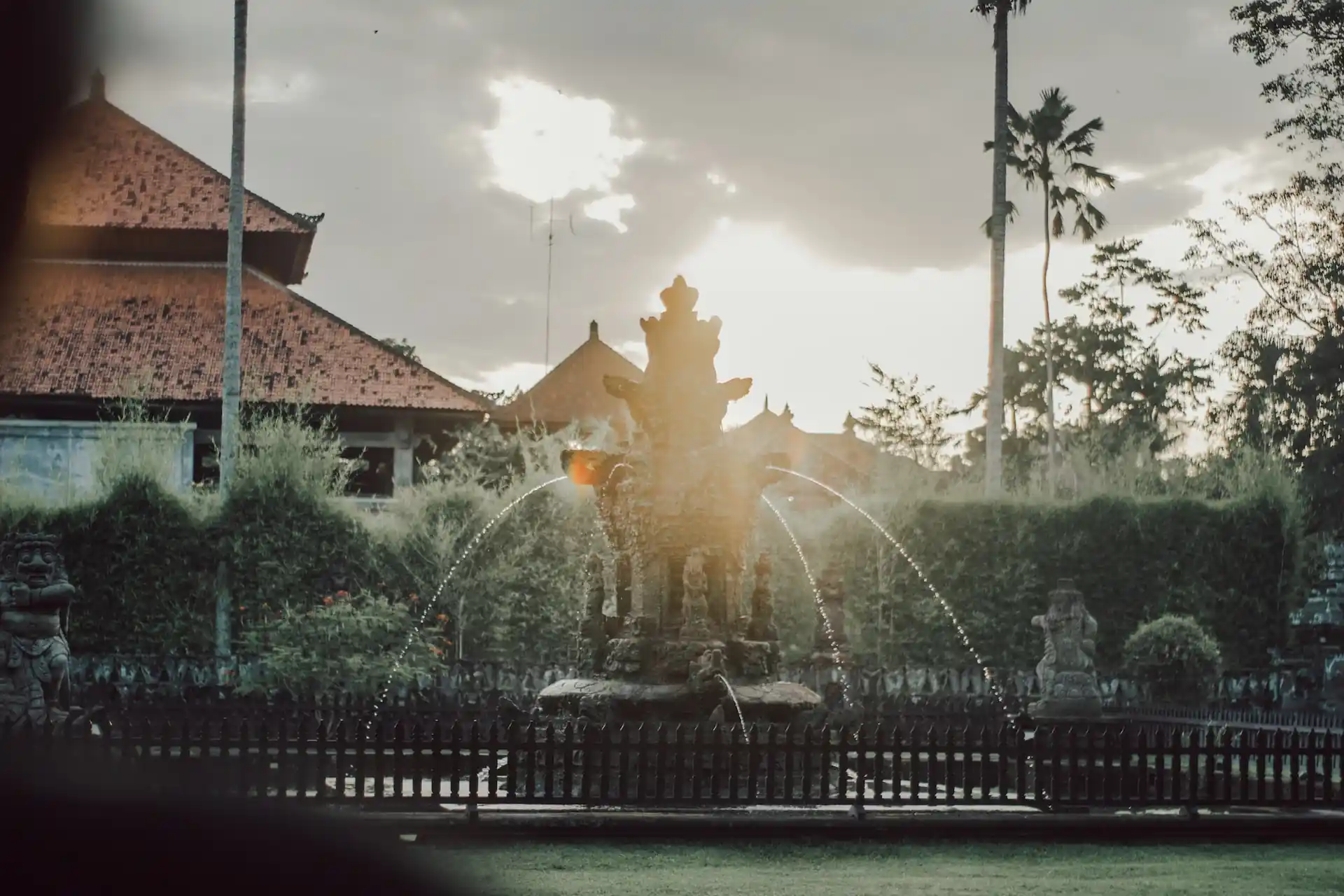
The Jaba, which is the Outer Yard, is located in the extreme south of the compound, and it serves as a serene place for rest. This section is beautifully landscaped with gardens and includes a Wantilan (a Balinese-style pavilion) for important performances, a ticket booth, and a small pond enhanced with a fountain. Other facilities are the Bale Bengong and the Siluh Resi Temple, which it has to receive visitors.
Jaba Tengah (Madya Mandala)
In the middle yard. In Balinese, known as Jaba Tengah, traditional Balinese statues stand representing the Dewata Nawa Sanga, the nine guardian gods of directions in Balinese Hinduism. Also, it is the dwelling place for many of the pavilions: Bale Loji, Bale Gong, Bale Kulkul, and Perantenan that play the role of the kitchen. All of them denote to the home premises that are culturally and spiritually sacred.
Jeroan (Utama Mandala)
In the main courtyard or the Jeroan or main enclosed rectangular room from the north to the south, it was enclosed by stone walls and surrounded by a broad moat. It contain several Pelinggih Meru(the multi-tiered roof shrines) with several sacred buildings. The design and layout of the yard model the sacred, ensuring both the function and beauty of the temple.
As told in the ancient Adhiparwa epic. The entire temple complex represents Mount Mahameru floating in the middle of the ocean of milk, portraying a significant cosmological concept.
Read: Temples In Bali
 Source: Unsplash
When and How To Get To Taman Ayun Temple?
Taman Ayun Temple is open to the public every day from 08.00 to 18.15. The best time to visit is when the sun is not so strong, there are two choices: morning at 09.00 or afternoon at 16.00. Not recommended to visit at 12.00 to 14.00, unless you are a sun lover.
If you depart directly from Ngurah Rai International Airport, it will take about 1 hour by private vehicle, motorbike or car. It is not difficult to find a vehicle rental place in Bali.
The entrance ticket to Taman Ayun Temple for local tourists is Rp. 15,000, while for foreign tourists the ticket price is Rp. 30,000. For motorbike parking fees, it only costs Rp. 2,000, Rp. 5,000 for cars and Rp. 10,000 for buses.
Read: Terasering Ubud Tourist Destination
Choice of Destinations Around
If you plan to come to Taman Ayun Temple, some of the places around it can be an option. This will also make it easier for you to arrange a vacation schedule. As a result, it minimizes the debate over the destination of the visit.
- Sangeh Monkey Forest. The distance from Taman Ayun Temple is about 12.5 kilometers with a travel time of 20 minutes.
- Bali Bird Park. The distance from Taman Ayun temple to Bali Bird Park is about 17 kilometers and takes 35 minutes.
- Ubud, Gianyar. The distance from Taman Ayun is about 17 km with a travel time of 45 minutes.
- Tegalalang Rice Terrace. The distance from Taman Ayun is about 25 km with a travel time of 53 minutes.
 Source: Freepik
Frequently Asked Question
1. Can People of All Ages Visit Taman Ayun Temple?
Absolutely, Taman Ayun Temple welcomes visitors from all age groups. Nevertheless, it’s suggested that older individuals or those facing difficulties with mobility consider using a cane or another form of walking support.
2. How Does the Galungan Festival Affect the Temple’s Atmosphere?
The Galungan festival significantly livens up the temple with a large influx of Hindu devotees and tourists, creating a more pronounced spiritual vibe. This period is perfect for those wishing to immerse themselves in the celebration’s vibrancy. Though it’s wise to anticipate larger crowds.
3. Are Visitors Provided with Information About the Symbolic Meanings Within the Temple?
Indeed, there are guided tours that provide in-depth insights into the temple’s symbolic elements. These tours are especially beneficial for visitors eager to understand the religious significance of the site.
4. Accessibility for Wheelchair Users at the Taman Ayun Temple?
While the temple is not fully equipped to accommodate wheelchair users, certain sections are accessible with some help.
5. Is Multilingual Tour Guidance Offered?
Guided tours are predominantly conducted in Indonesian and English. For guidance in other languages, it is advisable to arrange this service ahead of your visit.
Conclusion
Taman Ayun Temple may be the answer to your question. Related to the culture and religion that is so thick in Bali. Especially if you are someone who likes tradition and culture. Immediately arrange your vacation plans to Bali, and if you want to stay in Luxury villa in Ubud, then Ubud Villa Rentals by Red Lotus Bali Property offers many perfect accommodations for you.