Wayang Golek: The Javanese Puppets Indonesia
WhDo you ever play with puppets? You might have seen them as a playful toy from your childhood. However, the fact is puppetry has existed in world civilizations for more than 20 centuries (Ghosh, S., & Banerjee, U. K. (2006). Indian puppets. Abhinav Publications). It has served various purposes, ranging from sacred to profane. Cultural societies crafted these puppets as imitations and representations of revered figures. Among the various puppet variations developed, Wayang Golek from Java, Indonesia, stands out as a particularly popular one.
What is Wayang Golek?
The name Wayang Golek consists of two words. The term “wayang” originates from the word “Bayang,” meaning shadow, and further interprets as “mimicking an object.” Whereas Golek, according to The World of Puppetry, means wooden rod. Thus, it earns the name “Wayang Golek” due to its utilization of a rod as its mechanism for movement.
Based on its name, we know that the main material used to make Wayang Golek is wood, especially softwood such as mahogany and silk tree (Albizia). The primary objective is to minimize weight, ensuring ease of control with one or both hands during the performance.
The process of making Wayang Golek starts with carving the head part. Because this part usually has the most intricate design compared to other parts, since it symbolizes the characterization of a puppet. After creating the head and torso, it continues to make a hole to install a large rod from the neck to the bottom of the trunk. Next is carving the hand in two sections, shoulder to elbow and elbow to hand. A smaller rod is then mounted to each hand. After that, carve to make a body shape. The last part is painting and wearing clothes as well as accessories to clarify more about the character.
Javanese customary events, cultural ceremonies, or folk theater often showcase performances featuring Wayang Golek. Primarily utilized for entertainment, a puppet master known as the “Dalang” takes on the role of storyteller during the performance, accompanied by a traditional music ensemble called Gamelan. It often brought stories from religion-related epics like Ramayana or Mahabharata, Muslim literature, a folk story, or a made-up story with a touch of improvisation from the Dalang.
Source: Pixabay
The Origins and Development of Wayang Golek
There are many arguments about the history of Wayang Golek. Nevertheless, many strongly believe it originated on the north coast of Java in the seventeenth century. This has been related closely to the history of the kingdom era. The name and art of Wayang Golek began to arise during the expansion of the Mataram Sultanate in West Java. The contribution of the noble and upper-class society played a big role in its development.
The history of Wayang Golek has a close connection with Wayang Kulit (leather puppet) and the process of converting Java Island to the Islamic Religion after the downfall of the Majapahit Kingdom. Wayang golek was first introduced by Sunan Kudus in 1583, a medium of spreading Islamic teachings throughout the archipelago. He mixed daily life stories, coated with Islamic values and humor, to attract the public.
When Wayang Golek Have Been Popularity?
Wayang golek was commonly used by santri (Islamic students) and ulama (scholars). Its popularity increased following wide recommendations by Panembahan Ratu, who was king to the Cirebon Kingdom between the years 1640 and 1650. This continued to be so under the reign of Prince Girilaya. The further construction of the Daendels road caused the more rapid spread of Wayang Golek to the every corner of West Java.
Kathy Foley, in her article “Searching for Wayang Golek: Islamic Rod Puppets and Chinese Woodwork in Java” published in the International Journal of Wood Culture, highlights that craftsmen create the puppet in three dimensions, a departure from the two-dimensional Wayang Kulit. Thus, it can be performed during the time, unlike the 2D puppet model that depends on the Candle-light shadow. During that time, Muslim Spiritual Guides used Wayang as a medium for spreading Muslim doctrine through storytelling. Therefore, the presence of Wayang Golek was essential for distributing Muslim sermons in the daytime, completing the same role of Wayang Kulit in the nighttime.
Types of Characterization
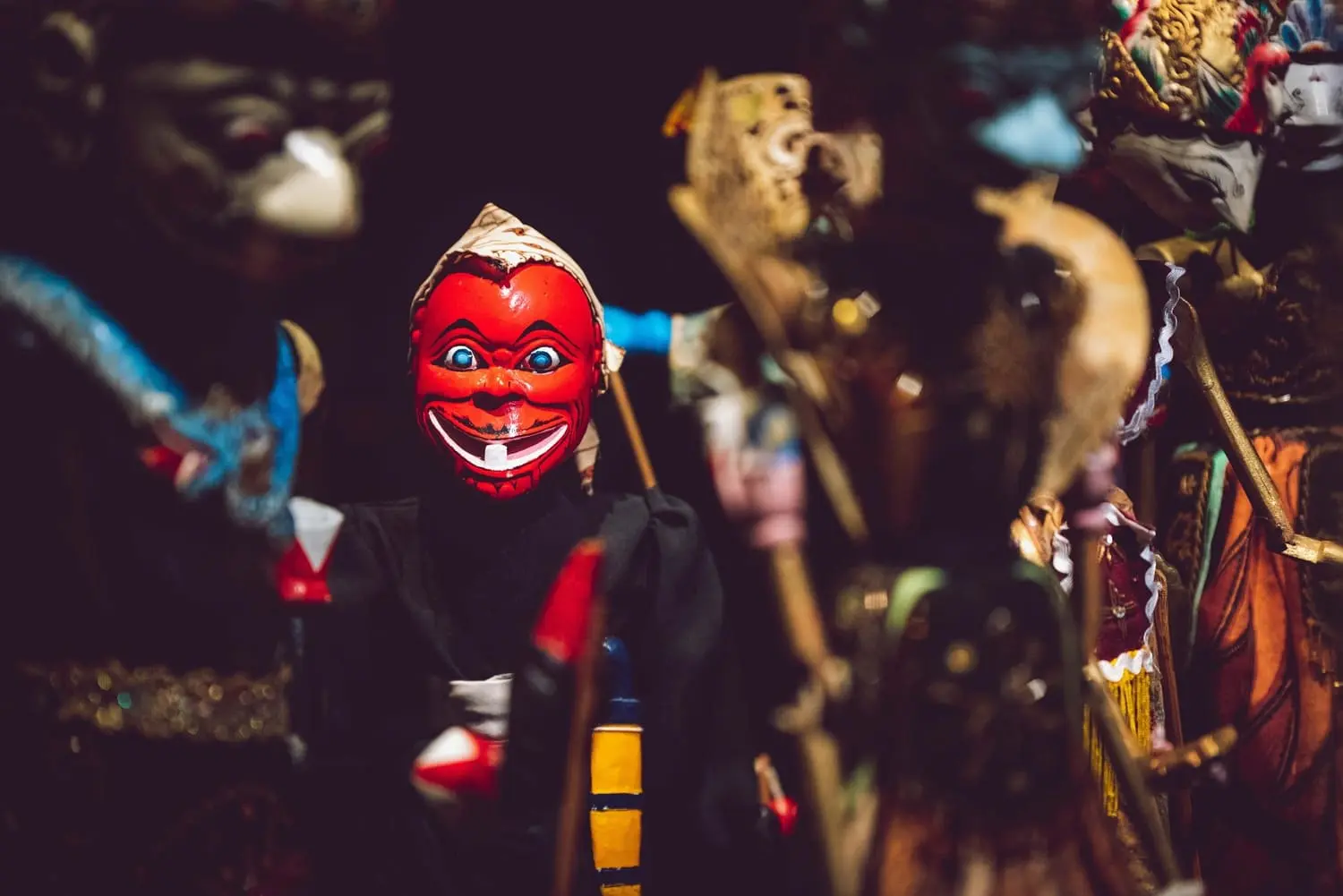
The uniqueness of this Javanese puppetry lies in the appearance that determines its character. According to The World of Puppetry Wayang Golek’s characterization is classified into five types, here are the differences:
- Refined Characters, we can see the traits from its white or bright face coloring tone, the slightly bowed head, tiny and downcast eyes, noble headdress, and luxurious accessories. This characterization commonly depicts the main protagonist or hero/heroine role.
- Semi Refined Characters, can be noticed from bright brownish facial color tones, and tiny eyes that gaze straightforwardly. They moved at a measured pace, with high-pitched tones of voices. Often used to depict the neutral character.
- Strong Characters, possess facial hues that range from intense shades of pink, blue, or other dark tones and have prominent bulging eyes. The head angle view is determined by its emotional state, bowed when feeling modest, and held high means it has gotten boastful. They are crafted with larger physical frames. The voices are firm and vibrant.
- Emotionally Uncontrolled Characters are depicted with red or dark faces, and eyes protruding with a grimace face expression. They also tend to have a large physique and hold their head up high. The tone of voice is shrill and high-pitched accompanied by an intense musical lilt. These characters are typically portrayed as antagonists.
- Special Characters, types that could not fit into any other group, have the most unique characteristics. typically combining or distorting a duality aspect, for example, white face and black body, strange behavior yet wise in speech, etc. It typically depicts jesters or whimsical characters that hold influence in the story. An example of this character is Semar.

Source: Unsplash
Why Wayang Golek Matters in Indonesia
Wayang Golek predates the establishment of the country of Indonesia. Indonesian society, particularly the Javanese, still values it, evidenced by its ability to endure changes in challenging times. From the historical value described before, Wayang Golek played an essential role in spreading the Islamic Religion on Java Island. Aside from that, during the kingdom era, not all social classes could access education. Typically, only the noble or upper-class societies can get the chance to study. Hence, watching Wayang Golek’s performance has helped Indonesian (especially Javanese) ancestors fulfill the need for knowledge back then.
During that period, the audience could actively acquire knowledge about language, literature, dialectics, ideology, and morals embedded in the stories. Nowadays, the performance of Wayang Golek still inserts some knowledge, philosophical thought, and moral value. Yet, it typically surrounds itself with humor or sarcasm, captivating the audience through insights into daily quirks and simultaneously entertainingly imparting knowledge.
Furthermore, there is also an art and cultural value to Wayang Golek. It has been meritorious to leave a trail of Indonesian heritage in the puppetry world. It has also become part of Javanese culture along with Wayang Kulit, Keris, Gamelan, Joglo building, etc.

Source: Pixabay
Legendary the Characters of Wayang Golek in Indonesia
In Wayang Golek’s stories, every character has their special features and quirks that make the story interesting. Below are some Wayang Golek characters, each with their own set of traits and personalities:
1. Duryodhana
Known as the chief antagonist of the Mahabharata, Duryodhana is the eldest of the Kurawa (Kaurava) brothers, who are the Pandawa brothers’ cousins and rivals. He is often portrayed as ambitious and unscrupulous.
2. Bima
Another key character from the Mahabharata, Bima is known for his immense strength and loyalty. He is the second of the Pandawa brothers, characterized by his straightforwardness and physical might.
3. Gatot Kaca
The Son of Bima, Gatot Kaca is portrayed as a knight with steel-like muscles and bones of iron in wayang narratives. He is famed for his extraordinary physical strength, effortlessly defeating enemies, and possessing the ability to fly. Gatot Kaca embodies the principle that humans should always uphold humanity’s values, cling to honesty and truth, and avoid succumbing to anger.
4. Arjuna
Arjuna appears as a man with a handsome face and a strong, well-built body. In the stories, he’s smart, nice, and wise. Armed with powerful weapons, he always looks out for those who are weaker. He is one of the Pandawa (Pandava) brothers, celebrated for his virtues and considered a model of chivalry and honor.
Wayang Golek vs Wayang Kulit, who’s better?
Wayang Kulit and Wayang Golek are two celebrated styles of traditional Indonesian puppet theater, each with its unique flair and method of presentation. But there are more differences between these Wayang, for example while both Wayang Kulit and Wayang Golek draw from the same epic tales like the Ramayana and Mahabharata, each form of puppetry offers puppeteers unique opportunities to interpret and unfold the stories in their ways.
Material-wise, they also stand apart. Wayang Golek features meticulously carved wooden puppets, while Wayang Kulit uses finely carved leather from cow or buffalo hides. The crafting process differs greatly between the two: Wayang Golek involves woodcarving and dressing the puppets, whereas Wayang Kulit focuses on detailed leatherwork. Both styles showcase remarkable artisanship.
Authentic Javanese Rod Puppet
Wayang Golek is a 3 Dimensional model puppet from West Java. The name Golek derived from the word wooden rod pointed out its mechanism. Sunan Kudus initially created Wayang Golek, using softwood as the primary material, to promote the spread of the Islamic Religion in Java. There are 5 types of characters classified by their appearance. Wayang Golek matters in Indonesia for the historical, educational, moral, art, and cultural value that it holds as part of Javanese culture.
Are you planning on a vacation in Bali with a touch of Javanese culture? we have a villa recommendation just for you. Villa Atas Awan, an exotic villa located in Ubud with two classic Javanese Joglo buildings. Book now and indulge in an unforgettable experience of comfort and relaxation like never before! You could also check for other exclusive villas at Ubud Villas Rental by Red Lotus.